Automatic Analysis of Mental Health by Machine Learning
PhD project of Martin, and ongoing research.
Motivation
This project focuses on improving the understanding of a variety of diagnosis, such as bipolar disorder, depression, autism, and more, which often remain undiagnosed or misdiagnosed for years, negatively affecting individuals and communities.
Previous studies have shown that facial expressions can reflect mental health conditions, e.g. revealing differences in emotional responses between individuals with bipolar disorder and healthy controls which provides a promising direction for further research. Additionally, deep learning and multi-modal approaches have been utilized on video data to classify mental disorders. While these approaches yield encouraging results, they primarily concentrate on predictions without deeper understanding on the subject matter at hand.
Building on this foundation, our research aims to explore various data modalities, including speech, facial expressions, and behavioral interactions, using standard, and advanced machine learning techniques specifically developed for this purpose.
These new algorithms, tailored to individual or combined modalities, i.e. multi-modal approaches, are designed to uncover novel insights into the mental disorders. For example, studies on postpartum depression have uncovered asynchrony between mothers and their children.
In the future we hope to help with the identification of subgroups within groups of people with the same diagnosis. Those findings can then be employed in personalized healthcare. Ultimately, this could pave the way for automated diagnostics in mental health care, revolutionizing treatment and intervention strategies, and making it more accessible to everyone.
Output and Current Work
I am working hard on contributing to advancements in the field of mental health by conducting research in the area of Machine Learning in mental health applications.
In this section I want to highlight funding and different ongoing projects and efforts, e.g. this growing collection of datasets with mental health labels.
Lundbeck Foundation
In 2022, I became member of the Lundbeck Foundation Investigator Network (LFIN), where I met Louise Birkedal Glenthøj. As a result in 2023 we were honoured to receive a seed funding grant from the Lundbeck Foundation supporting this line of research for one year.
In our joint work we investigated differences in facial expressions between people diagnosed with being UHR (Ultra High-Risk of psychosis) and healthy controls. In 2026, we finally published our related paper, thanks to leading efforts of Tina Dam Kristensen (see below).
This was right in time before my 4-year membership, and my role as a board member ended, which makes me a proud alumni of the first cohort.
Since August 2025, I am director of the program Bridging Minds and Machines: AI, HCI & Psychology. Louise Birkedal Glenthøj, Niels van Berkel, and I each represent one domain of the multi-disciplinary collaboration.
Our main inceptive is to connect researches cross disciplines to tackle challenges with our joint expertise.
So far we have organized a lecture series, and networking meetings.
D3A
At the yearly D3A conference, I am co-organizing sessions related to mental health topics:
Emotional processing deficits are increasingly recognized as a salient feature of psychotic disorders, and emerging evidence suggests that impairments in facial emotion processing may serve as additive predictive markers for individuals at ultra-high risk (UHR) for psychosis, highlighting the importance of such deficits for early identification and intervention strategies. In this study we examined whether automated coding of facial features from brief video recordings (45 seconds) could discriminate 108 individuals at ultra-high risk for psychosis (UHR) from 65 matched healthy controls (HC). We assessed the alignment between automated coding of facial expressivity as measured by granulated muscle activity, and clinician-rated facial emotional expressivity by experienced clinicians. In addition, we explored associations with social skills and clinical symptoms. A random forest classifier with repeated nested cross-validation significantly classified UHR-individuals from HC with above chance accuracy (63%; p = 0.009, sensitivity=0.76, specificity=0.40). Automated coding of Presence, Intensity, and Variation of specific facial features correlated strongly with clinician-rated facial expressivity with moderate to large effect sizes (all corrected p \textless 0.001). Moreover, facial feature metrics were associated with attenuated psychotic symptoms and negative symptoms, supporting the clinical validity of automated facial expressivity coding from brief video recordings of UHR-individuals.
2026
Don’t predict if you cannot interpret: investigating the clinical viability of facial movements for machine-learning assisted diagnostics of bipolar disorder
Martin Lund
Trinhammer
, Stella
Graßhof, Lars Vedel
Kessing
, and
3 more authors
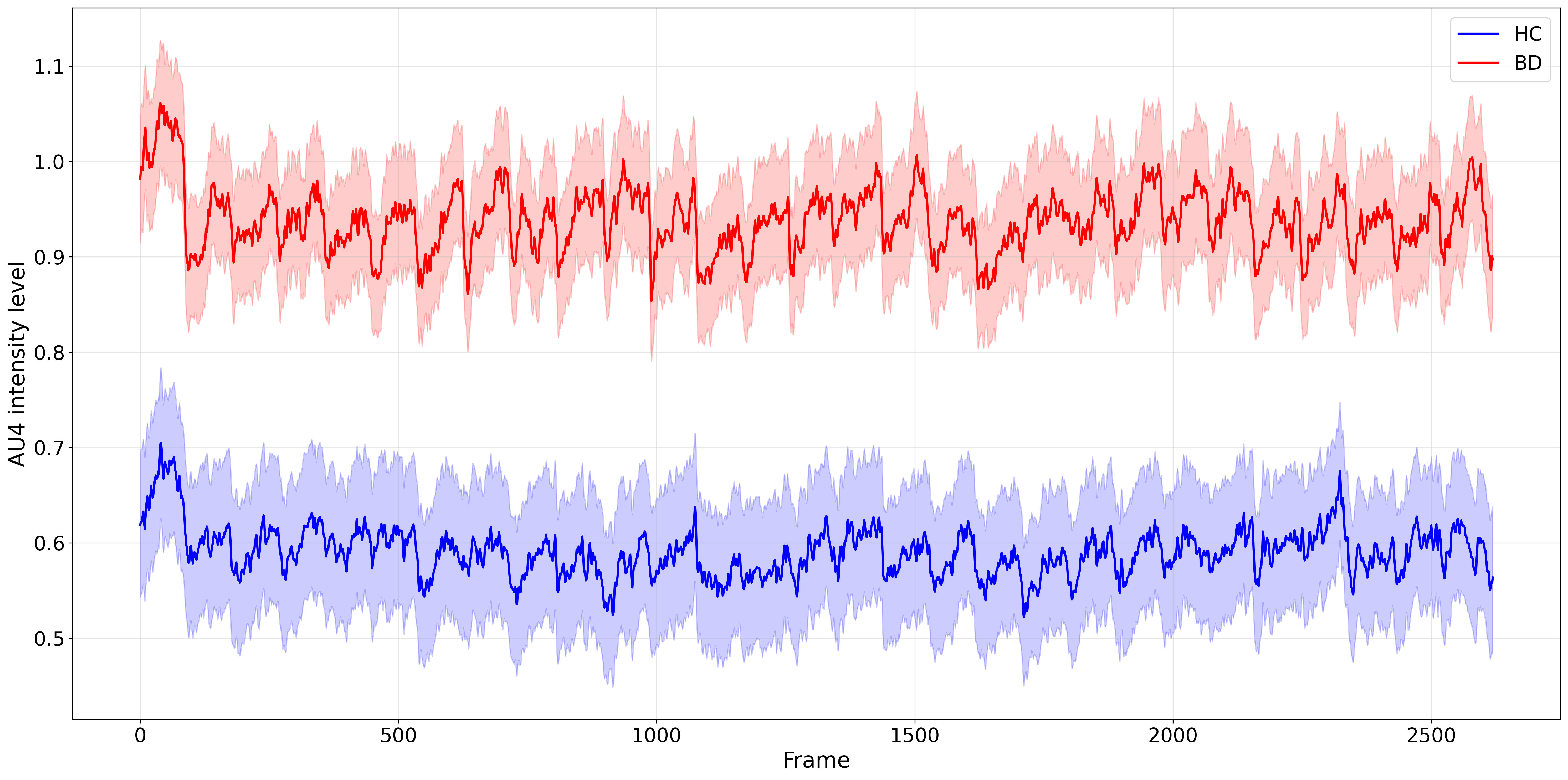
Numerous studies have explored the possibility of developing automatic detection pipelines that can seamlessly diagnose patients with bipolar disorder (BD) and other mental illnesses. Such novel diagnostic tools increasingly rely on data sources, such as facial movements, whose relationships to BD have yet to be fully elucidated. As such, these detection pipelines offer limited clinical value, despite promising performance estimates. A vital next step toward achieving clinically reliable models is to conduct granular interpretability analyses to determine which subsets of facial movements are responsible for determining patient or control class membership. In this work, we rely on facial movements encoded as Action Units (AUs) of 32 participants recorded while watching emotional film clips. Our objective is to delineate the specific facial micro-movements responsible for the differences between patients with BD and controls by applying the interpretable Fisher’s Linear Discriminant Analysis (LDA) in a binary, supervised classification design. We report how the movement of brow lowering (AU4) differentiates patients from controls with AUROC scores up to 69%. Our exploratory study argues for the necessity of devising inherently interpretable machine learning models for the clinical domain. Furthermore, we critically discuss the implications of identifying AU4 as a key discriminative feature and assess the clinical value of specific facial movements for the diagnostic process.
2026
Evaluating Open‐Source Solutions for Computerized Inference of Infant Facial Affect
Martin Lund
Trinhammer
, Ida
Egmose
, Marianne Thode
Krogh
, and
4 more authors
Infant affect is often expressed through facial expressions, making this modality a key source of insight into the child’s well‐being and social functioning. Computational inference of infant affect could critically assist both researchers and clinicians working with infant development and mitigate the need for manual coding. While many studies have explored open‐source solutions in the adult domain, only the commercial Baby FaceReader 9 exists for the infant domain. To address this gap, we utilize the recently proposed, open‐source infant‐native action unit (AU) detection library PyAFAR (Python‐based Automated Facial Action Recognition) on a sample of 71 four‐month‐old infants, whose facial expressions were manually annotated frame‐by‐frame for three minutes according to the Infant Facial Affect (IFA) coding scheme. Using these AUs as features, we classify facial affect into negative, neutral, and positive using XGBoost and Bayesian filtering, both in a multiclass and a binary setup. Our results show that AUs estimates from PyAFAR, combined with an XGBoost classification model, can distinguish positive from neutral and positive from negative affect with AUC scores of 0.78 and 0.76, respectively. This performance is essentially on par with that reported in evaluation studies of the Baby FaceReader 9, when accounting for differences in study setup. Our work indicates that the area of infant facial affect is particularly well‐suited to supervised learning, given the availability of two distinct, commensurable measurement schemes that underpin the same phenomenon. Finally, we discuss how future iterations of PyAFAR may benefit from including AUs that capture more variability around infant forehead and mouth opening.,
Open‐source models for infant face detection and action unit estimation enable comparable affect estimation compared to commercial tools.The two main measurement schemes used for annotating infant affect are highly commensurable, suggesting a fruitful avenue for imitation learning.Next iterations of infant action unit detection models may benefit from incorporating features specific for infant forehead activation, mouth opening, and mouth widening